Bronze Age Beginnings

Showing posts with label roy thomas. Show all posts

Monday, 11 August 2014

From the Savage Land to an Alternative Earth: Steve Englehart’s Avengers from 1972 to 1976..

A Prologue.

After six years, it was time for Roy Thomas to move on. He handpicked his successor, Steve Englehart - a recent addition to the Marvel Bullpen - to continue chronicling the adventures of Marvel’s premiere team, and in doing so, kick started Marvel resolutely into what is now fondly referred to as the Bronze Age of comics (by fans of a certain age).

Englehart’s writing career at Marvel - leaving aside a few done-in-ones for the mystery and romance mags - began in earnest with The Beast feature in Amazing Adventures #12 (on sale date February 1972), before taking over as the regular writer on Captain America with #153 (on sale date June 1972). Just two months later he took on the writing duties of Earth’s Mightiest Team, with the Avengers #105 (on sale date August 1972).

It wasn’t a completely smooth transition though, as Roy Thomas left a number of dangling plot lines for Steve to pick up on, not least the developing romance between the Scarlet Witch and The Vision - brewing since just before the start of the Kree/Skrull War -, and The Grim Reaper’s macabre offer to The Vision in #102. Luckily for Thomas, Englehart was one of the new breed of creators, raised on Marvel’s continuity conscious comics of the ‘60s, and not afraid to play with the tapestry that Lee, Kirby, Ditko and many others wove during the preceding decade.

Saturday, 29 December 2012

A girl named Frankie Raye


Face it tiger...oops, wrong redhead.


When John Byrne took the Fantastic Four Back to the Basics with Fantastic Four Vol. 1 #232 (cover date July 1981) it was a rather apt title considering his stance, in interviews at the time (if recall correctly), that nothing that came after Jack Kirby left the Fantastic Four with Vol. 1 #102 (cover date September 1970) ‘counted’, essentially ignoring the previous decade; or, to put it another way, the entirety of what we now fondly refer to as the Bronze Age of Marvel Comics. Byrne had sole responsibility for shaping the future of the Fantastic Four as both artist and writer, so he had to trust in his creative instincts; but it still seemed a tad disrespectful of all the other creators that came before him.

 It was a little odd, then, that in his first issue he used a character created by Roy Thomas and George Perez in Fantastic Four Vol. 1 #164 (cover date November 1975); Johnny Storm’s red-haired flame (pun intended), Frankie Raye. Frankie was Johnny’s only Bronze Age romantic entanglement after Crystal left the team (and later married Quicksilver), but only appeared a handful of times (the last being Vol. 1 #204 March 1979 – more than two years prior to the start of John Byrne’s run). Could it be that Byrne had been told something about the creation of Frankie Raye - that she was originally intended to be the daughter of Toro, the original Human Torch’s sidekick* - that he felt he could repurpose her for something else he had planned?** Do all red-haired girls have to ‘go bad’ in the end?

Johnny’s first date with Frankie (a’ lonely U.N. translator’ he met in a ‘ 2nd Avenue singles bar’) starts well as they wander from Art Fairs to Rock-Joints in New York’s Greenwich Village, but all good things must come to an end as The Crusader attacks. Johnny resists flaming-on - not wanting to reveal who he is to Frankie - but his hand is eventually forced; Frankie’s reaction shot by George Perez is a portent of what is to come.

The next time Johnny and Frankie meet up is in Fantastic Four #171 (cover date June 1976) at Central Park Zoo. They discuss why Frankie ran off the last time, and she explains that seeing Johnny become the Human Torch freaked her out. Unfortunately, just as Johnny tries to convince her that he is considering giving up the superhero life, and that she might just be the one, a spaceship lands and out comes Gorr – a giant golden gorilla. Johnny immediately flames-on, but then reconsiders and returns to Frankie, as the ‘police can handle that overgrown ape, soon as they get some heavier guns.’

A short time later, at Frankie’s apartment, Johnny overhears on the radio that his fellow teammates are helpless before Gorr, so with Frankie’s protestations ringing in his ear he flames-on and leaves. Frankie ‘suddenly knows the truth at last…that all this has happened to her…before!’

I wonder what that could mean?

It is another ten issues, in Fantastic Four #181 (cover date April 1977), before Frankie makes another appearance. Johnny is hanging around Greenwich Village in the hope of seeing Frankie again, and when he does she’s with another man. Johnny and Frankie argue, with Johnny making light of her fear of fire, so Frankie leaves. Johnny flies off, promising to ‘find out why you’re so traumatised by fire…if it takes forever!’

Considering this was Roy Thomas’ last issue, Johnny might be waiting some time.

Len Wein picks-up the Frankie and Johnny (non) relationship another ten issues later, in Fantastic Four #191 (cover date February 1978), when Johnny calls on Frankie - hoping to rekindle their romance - but is called away by the Fantasti-Flare before she can answer the door.

It is only another 13 issues until Frankie makes her last appearance during the Bronze Age, under the pen of Marv Wolfman, in Fantastic Four #204. Johnny bumps into her while enrolling at Empire State University, and while they discuss why they never quite got together in the past, Frankie gives her reasons as ‘never liked dating a superhero…or got used to you standing me up…or rushing off halfway through a date…or’ before being cut-off by an emergency call from Reed.

Presumably her next line was going to be ‘… or you turning into a human matchstick, and I hate fire’ but I suspect that plot point was being quietly buried.

Anyone that has read John Byrne’s 5 year + run on Fantastic Four knows that he eventually revealed Frankie to be the step-daughter of the original Human Torch’s creator, Phineas Horton. At the age of 14, she’d been accidentally doused in chemicals that gave her the power to burst into flame, but Horton hypnotised her into forgetting these events, while giving her a costume that mysteriously only appears when she is naked. Yeah, that never made complete sense to me, but it did give Byrne the chance to show the slightly salacious scene of Johnny gawping at a slowly disrobing Frankie.

Byrne teased his readers with the idea that Frankie might join the Fantastic Four, but over a few adventures he had Frankie show a disturbing propensity for violence and callousness, that ultimately culminated in her accepting a new job as Galactus’ herald, receiving the power cosmic, and becoming Nova.

While Frankie/Nova is apparently dead in current continuity, Byrne did originally intend to have Nova become the next Galactus, after another Big Bang at the culmination of his ‘ The Last Galactus Story’, the ending of which remains unpublished today.

I ask again, do all red-haired girls go bad eventually? Frankie’s sad fate has an echo of that other red-haired girl gone bad, Jean Grey/Phoenix, and I sort of wish that Roy Thomas had seen his plot for Frankie Raye through. Who knows, she might even be in the X-Men now, as the mutant daughter of Toro.

*I have only seen this referenced once online, as told to John Byrne by Len Wein, but can’t find anything else to corroborate it. It may be false, but given Roy Thomas’ predilection for using Golden Age characters and stitching them into then current continuity (see Giant-Size Avengers #1)…it has a ring of the truth to it.

**At a later date, Byrne also made reference to Frankie being Ann Raymond and Toro’s step-daughter in Avengers West Coast #50, so while it probably negates Roy Thomas’ earlier intent, it does at least acknowledge the connection.


Sunday, 29 July 2012

The Summer of '76


The Summer of ’76 was notable for many things. The UK was roasting in a heat-wave;  ABBA  was camping up the charts with Dancing Queen and Rod Stewart was singing about The Killing of Georgie. I was 11 years old; I’d moved up to big school, AND started my first job as a Paperboy. Things were good; school holidays seemed endless and I had my own money to spend on comics.

So what was I spending that hard-earned (dragging the Sunday papers around Highbury Hill at 7AM was hard labour!) cash on? What Bronze Age Marvel comics caught my eye in July 1976?

The Avengers #149


Steve Englehart was only two issues away from ending his era-defining run on The Avengers (and his time at Marvel during the Bronze Age) but before then he had to finish up a memorable multipart storyline in which The Avengers came into conflict with The Squadron Supreme, The Brand Corporation, Roxxon Oil, and The Serpent Crown. Oh, and he introduced Patsy Walker as The Hellcat.

The Defenders #37


Steve Gerber was spinning a lot of plates during the final stretch of his run on The Defenders. While Dr. Strange and Red Guardian were fighting off Plantman’s giant dandelion puffs, Kyle (Nighthawk) Richmond was still suffering an existential crisis from having his brain removed earlier, and Valkyrie was incarcerated in a women’s prison. Meanwhile, Nebulon was recruiting more costumed crazies to his Bozo cult…

The Fantastic Four #172


Bill Mantlo had the Fantastic Four battling a giant golden gorilla called Gorr, from Counter-Earth; a world created by the High Evolutionary, which was now under threat from Galactus and his new Herald, the Asgardian Destroyer armour.

Howard the Duck #4


Steve Gerber again, on his most personal series; the tale of Paul (Winky Man) Same, a man with a sleeping disorder and the inability to confront those who push him around.

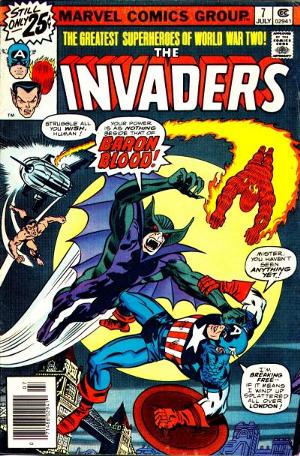
The Invaders #7


Roy Thomas introduces us to the Falsworth’s; an upper-class family that includes World War I hero Union Jack, his daughter Jacqueline (who would later become the plucky heroine Spitfire after a blood transfusion from the android Human Torch) and nephew John, the Nazi vampire Baron Blood.

Obviously team books were what caught my eye during that blazing hot month; more heroes for my pennies, but also some exemplary comics. Steve Englehart’s Avengers (drawn by George Perez) never failed to entertain, and Steve Gerber’s comics left an indelible impact on my early teen self. I personally consider Englehart and Gerber to be the two pillars of Marvel’s Bronze Age, defining the era with their creativity and individual insight.

The Fantastic Four cover had floating heads which was always a must buy, and how could I resist that funky looking vampire on the cover of The Invaders? I don’t recall much of that period of the Fantastic Four - was this when the evil Reed (Brute) Richards from Counter Earth trapped the good one and replaced him on the team? - but I absolutely loved these early issues of The Invaders with art by Frank Robbins.

July ’76 filled my head with alternative Earths, Counter-Earths, giant golden gorillas and dandelion puffs, Bozos and Nazi Vampires, and taught me to stand up for myself for fear of running around at night wearing a night-shirt and cap! It was truly a Bronze Age smorgasbord.


Sunday, 8 July 2012

Giant-Size Avengers #1

In the mid-70s there were some comics I wanted more than all others, and Marvel’s line of Giant-Size comics were undeniably the most coveted. They promised much, yet were denied me because of their non-distribution status in the UK. My hopes were raised by house-ads in the regular comics, and dashed by their lack of availability in the many newsagents I would frequent in my weekly search for new comics.

One in particular fascinated me; the cover of Giant-Size Avengers #1 promised the ‘startling reappearance of the fabled All-Winners Squad’ - a team of Golden Age characters I’d discovered recently in a battered copy of Fantasy Masterpieces #10 - and furthermore, I’d been made aware (most likely by an Editor’s note in a later issue of The Avengers) that it was the comic where it was revealed that The Scarlet Witch and Quicksilver were the children of Bob (The Whizzer) Frank and Madeline (Miss America) Joyce. Being a fledgling continuity obsessive, and fan of stories that filled in the gaps of the rich tapestry the Marvel Universe once was, Giant-Size Avenges #1 made me think this one would live up to Stan Lee’s oft- repeated declaration that ‘This one has it all true-believer’.

I never did get hold of a copy during those formative years, but on eBay all things are available (for a price), and so I now own a copy of this once highly sought after comic.

Was it worth the 38 year wait? It certainly scratched a Bronze Age itch; the story of Nuklo - mutated by the terrible power that had just recently devastated Hiroshima and Nagasaki; a child in possession of uncontrollable force and locked away for 25 years - was a sad acknowledgement of Man’s unknowing use of nuclear energy, written by Roy Thomas and drawn by Rich Buckler (inked by Dan Adkins). However, the reveal of the parentage of the mutant twins was slightly anti-climactic, almost tacked on in Thomas’ quest for a cohesive Marvel Universe. It was likely this lack of a solid underpinning that allowed for the later reveal that the twins were the children of Magneto.

Still, it stands as an interesting artefact of Marvel's Bronze Age. And one can't condemn something for not entirely living up to childhood expectations.

Buy Giant-Size Avengers #1 at My Comic Shop

Saturday, 31 December 2011

The Avengers #98

Cover date: April 1972

Writer: Roy Thomas

Artist: Barry Smith

Inker: Sal Buscema

Following the events of the Kree-Skull War, it’s time for the Avengers to take stock and ask some important questions... like, where is Clint (Goliath) Barton?

Last seen upon an exploding space craft, the gathered heroes are uncertain whether their missing teammate survived; so Thor announces he will return to Asgard (to peer into some mystic mirrors looking for answers), Iron Man reckons Tony Stark (wink wink) has some other resources that’ll help in their search, and Captain America puts on the radio...to discover that a pro-war rally – led by a Mr. Tallon – is taking place in the city.

As acting Chairman, the Vision sends Cap, the Scarlet Witch and Quicksilver (with Rick Jones tagging along) to investigate Mr. Tallon and his Warhawks, but all are soon swayed to the pro-war sentiment by the mysterious music played by Mr. Tallon’s two robed associates.

Meanwhile, Thor has returned to Avengers Mansion, unable to enter Asgard (this tale apparently takes place before, or perhaps after, the ‘legendary’ events of Thor #198). The Vision tries to contact Iron Man, but he too has fallen under the spell of Mr. Tallon; so it is left to the android and the god (both immune to the other-worldly music) to make things right.

The Vision sends Thor to the rally, while he goes to confront Iron Man. After a titanic tussle, Iron Man is freed from the spell when another of the pan pipers is killed in the clash. The two then join Thor, who recognises Mr. Tallon as Ares, the Greek god of war.

As Thor’s mighty hammer is caught in one of the Scarlet Witch’s hex spheres, an explosive arrow flies towards it, disabling the hex and allowing the hammer to return to Thor. The Vision makes quick work of the two remaining pipers, revealing them to be Satyrs, and the crowd (and the other Avengers) are returned to normal. The mysterious archer then makes himself known. It’s Clint Barton, in a hideous new outfit, and again calling himself Hawkeye. Putting off any questions to how he survived being stranded in space, Hawkeye announces he has a companion – an amnesiac Hercules!
This was a strong return to form for Roy Thomas after the mangled climax to the Kree-Skrull War, and he is ably abetted by an ever improving Barry Smith. Smith still has some problems with faces (the eyes are invariably too close together), but his storytelling is effective, clear, and dynamic.

Shame about that new outfit for Hawkeye though; what an eyesore!


Wednesday, 20 July 2011

Marvel Team-Up #1

Cover date: March 1972

Writer: Roy Thomas

Artist: Ross Andru

Inker: Mike Esposito

It’s Christmas Eve, and Peter Parker is on an assignment for The Daily Bugle. J Jonah Jameson has requested pictures of some hardy winter swimmers at the beach, so Peter is on hand when Sandman makes an unscheduled appearance. After the obligatory tussle, Sandman makes his escape when Spider-Man mentions what day of the year it is.

Reasoning that Sandman isn’t his problem, as he only fought him once a long time ago and he’s got a date with Gwen that night (whither great power comes great responsibility, Spidey?), Spider-Man heads for the Baxter Building.

As Spidey attempts to enter the building, he narrowly misses some fire-rings that Johnny Storm (The Human Torch) is idly shooting out of the window. Johnny is alone (the other members of the Fantastic Four are at Whisper Hill for Christmas), and in a mope about girl-problems. Spider-Man mentions that he fought Sandman in New Jersey, and Johnny remembers that he first encountered Sandman on George Washington Bridge (in Strange Tales #115). Putting two and two together, and perhaps coming up with four, Spidey agrees to accompany Johnny in the Fantasti-Car to George Washington Bridge, and then over to the Jersey side. While on the look-out for Sandman, Spidey spies a mugging in progress and goes to the victim’s aid. In the spirit of Christmas, the woman* involved decides to let the thwarted muggers go - after Spidey has detained them with webbing for a bit.

Continuing on, The Human Torch gets to show his stuff by stopping an out of control truck, before they spot Sandman. Challenging him, both are out-witted (it ain’t hard), and Sandman dumps them, tied up together, into a water tower. Knowing these two will need all the help they can get, Sandman drops Spidey a handy hint as to how they can escape.

After escaping the death-trap, the two spot Sandman climbing through a window. Following him into the house, they’re met by Sandman in civvies (he’s called William Baker here; isn’t his civilian name Flint Marko?) He tells them to keep it down as he is there to see his old sickly mum, and agrees to give himself up if they give him a few minutes with her. This gives the two an excuse to remember their nearest and dearest; so Peter thinks about Aunt May for a bit, and Johnny mopes some more about Crystal.

As you might guess, after his five minutes are up he escapes down the plug-hole leaving just a few grains of sand behind.

Roy Thomas pulls out all the stops to give us a warm Christmas glow, yet it all seems a tad perfunctory with some lapses in logic. Would a villain on the FBI’s Most Wanted list really tell Spider-Man how to escape a death-trap?

The two co-stars work well together, trading quips back and forth, but both appear a bit callow and I generally like my heroes a little less self-absorbed. All in all, not a great example of a grand tradition - the comic book Christmas tale.

*The unnamed woman is later ret-conned into being Misty Knight’s first appearance by Chris Claremont; presumably because she’s black and has an afro.


Saturday, 2 July 2011

Marvel Feature #2

Cover date: March 1972

Writer: Roy Thomas

Artist: Ross Andru

Inker: Sal Buscema

If it’s Halloween, we must be in Rutland, Vermont. Cue the obligatory Bronze Age cameos for Tom Fagan and a Marvel writer; in this instance Roy Thomas (with wife Jeanie)*.

It’s the night before All-Hallows Eve, and some witchy folks in robes are summoning The Dread Dormammu. When he shows up he isn’t too pleased. What he needs is the vessel to escape his otherworldly dimension, and in this instance that would be Dr. Strange (just his body will do). Some of those same witchy robed folks have journeyed to New York’s Greenwich Village and the good doctors Sanctum Sanctorum, where they trick Dr. Strange’s astral self from his body so they can kidnap it before returning to Rutland. Wong puts up a good fight but soon succumbs; luckily he was on the telephone to Clea at the time. She soon arrives, and after Wong fills her in decides she better summon some help. Interestingly, it appears that Stephen Strange and Clea are on the outs at this time, and her powers have waned somewhat.

Using the Eye of Agamotto, Clea manages to broadcast an image of Dr. Strange to two recent allies, Namor the Sub-Mariner and the Hulk, and both answer the summons to New York and a dark alley where Clea and Wong are waiting. After dressing Namor in some civilian wear, Clea hypnotises Hulk into transforming back into Bruce Banner and gives him some tranquilisers to keep his mood swings in check. They then catch a bus to Rutland to rescue Dr. Strange’s body.

Up on Bald Mountain, proceedings have begun to release Dormammu so he can reside in Dr. Strange’s body and conquer our dimension. Our intrepid band of rescuers climb the mountain, battling witchy robed folks on the way, and when they reach the summit, just as Dormammu appears, Dr. Strange’s astral self shows up - he was hiding within Wong. A battle ensues, and Dormammu is once more banished.

Roy Thomas’ script is efficient at bringing these three very different characters together, but if The Defenders are to continue as a team, a less convoluted means will need to be found to accomplish that on a regular basis. The concept does have a lot of potential though, and I enjoyed the interaction between the three leads (+ Clea). Ross Andru, inked by Sal Buscema, captures the mood necessary to this type of story, filling the pages with an eerie atmosphere and strong storytelling (and his Clea is a delight too -weird hair and all).

*last seen in The Avengers #83

*********************************************************************************
There’s also a ‘fabulous Fifties featurette’, from Sub-Mariner Comic #36, showcasing Namor’s astute Atlantean intelligence. After helping an alien world drain the Earth of its water, Namor suddenly realises...

“Ah...good! Now the sun will go to work, and the world’s population will perish without water!! Oh, what sweet revenge! At last I’ve gotten even! But...WAIT!!! What have I done??? Without water, my own race will die off, too!!!”

Oh, Namor...

Monday, 25 April 2011

From out of the past! The lovely, lethal Asbestos Lady!

I was a complete sucker for Golden Age characters growing up; I think it was a mixture of miss-placed nostalgia, and the implied history/continuity of the heroes I'd only recently discovered. So, The Invaders, by Roy Thomas, was a nascent fan-boys dream. And regardless of what seems popular opinion, I absolutely adored the art of Frank Robbins; Robbins art perfectly captured the 'look' I expected of Golden Age characters and stories (at this point I'd only seen a few in the pages of Fantasy Masterpieces).

As you probably gather from the cover, this issue chronicles the never before revealed origin of Toro. Or, rather, a Roy Thomas' retcon. While I grew to, not hate, but certainly disdain retcons as I grew older, then I absolutely adored these secret histories and whatnot.

The Invaders are returning to England from various missions in the Third Reich, with a severely injured Toro in tow. This is a perfectly suitable, though slim, excuse for Roy Thomas to reveal the origin of the Human Torch's young ward - and what a mixed up origin it is.

Toro's parents used to work in various sciences, his father (Fred Raymond) being an expert in flame-proofing, and his mother (Nora) indulging in a spot of hazardous experiments with Radium.
You just know that isn't going to end well.

So, despite both becoming sick, they decide to marry and have a baby! Along comes Toro (named as such for reasons unknown, but I'm going to guess that they just wanted him to suffer), and they get progressively sicker until The Asbestos Lady turns up wanting Fred's help in her quest to further the criminal possibilities of asbestos (!) The Human Torch arrives to prevent Fred's kidnapping, and is then told all about the remarkable Toro who exhibits invulnerability to flames. Nora calls him a mutant (a result of their hazardous careers).

Sheesh! First they decide to have a kid when they both know they're dying, regardless of any possible complications (like a mutant gene), and then call him Toro into the bargain. He never had a chance. At least his mutant gene only made him flame-proof, eh?

Anyway, Fred gets a call telling him that Nora's only got a few weeks left, so sensibly he decides to take them all on vacation. Watch out for that tree trunk on the tracks, Fred.....too late. Toro survives the crash (because flames are his friend), and, erm, gets taken in by a kindly fire-eater couple from a passing Circus. They hide him from the authorities, because, you know, they want a son.

Now I know why Fred and Nora called him Toro - they were planning ahead for his future career in the Circus!

Then, one night, the Human Torch comes looking (because he's a bit lonely for his own kind - sorta), and his mere presence (and intense heat) causes Toro to burst into flame too.

And start calling the Human Torch, erm, Pappy.

Despite all the ridiculous elements, this comic exhibited the same charm I found so endearing when I was 12 years old. Roy Thomas knew he had a mountain to climb to try and make some sense of Toro, and he did what he could. Unluckily, if you come looking for the wonderful art of Mr Robbins, you'll be disappointed - the issue is drawn by Jim Mooney and inked by Frank Springer. They do a good job of capturing the existing feel of The Invaders, but lack Robbins' crazy anatomy.

Tuesday, 22 June 2010

The Avengers #97

Cover date: March 1972

Writer: Roy Thomas

Artist: John Buscema

Inker: Tom Palmer

I love this cover!

This is the final part of the Kree/Skrull war, and Rick Jones has been hurled into the Negative Zone to be menaced by Annihilus. One quick, unexpected, mind-blast from Rick and Annihilius is beaten, before Rick is transported back to the Supreme Intelligence for an explanation of where the mind-blast came from. It appears Rick is exhibiting the ultimate expression of the evolutionary capacity of the human race – handy that, because he then whips up the Golden Age heroes that appear on the cover, to fight of some Kree soldiers and Ronan the Accuser!

Rick then puts an end to the war by immobilising all the Kree and Skrull troops, before collapsing. Never fear, Captain Mar-Vell is on hand to merge with Rick and restore him to good health.

The Avengers return home, minus one. Clint ‘Goliath’ Barton is missing, presumed dead!

A satisfying conclusion to the first real Marvel epic, spoiled only slightly by some questions regarding just what is going to happen once all those Kree and Skrull come around– the Skrull Armada is still floating around out there in space!

It’s a pity that Neal Adams wasn’t able to complete the story, but Buscema inked by Tom Palmer is more than palatable.

Buy The Avengers #97 at My Comic Shop

Sunday, 16 May 2010

Astonishing Tales #10

Cover date: February 1972

Writer: Roy Thomas & Gerry Conway

Artist: Barry Smith and Sal Buscema

Inker:

This is the scrag end of a three-part story involving some soldiers - German and English - from WWII, continuing to fight the good fight after they somehow ended up in the Savage Land; with a twist. Naturaly, Ka-Zar and faithful Zabu put an end to that.

Admittedly, I wasn’t much looking forward to reading this as I’ve never been too fond of this particular Tarzan knock-off (except for the early Eighties Bruce Jones and Brent Anderson run), but it wasn’t that bad. Conway pitched in to help Thomas out, and I’m going to hazard a guess that Smith provided lay-outs for Buscema, as the art lacks Smith’s customary detail. Of note, there is a very brief appearance by Barbara ‘Bobbi’ Morse, the future Mockingbird and Mrs Hawkeye.

Buy Astonishing Tales #10 at My Comic Shop

Friday, 16 April 2010

The Avengers #96

Cover date: February 1972

Writer: Roy Thomas

Artist: Neal Adams

Inker(s): Palmer, Adams & Weiss

The Avengers - Captain America, Thor, Iron Man, Vision and a powerless Goliath (Clint Barton) - race into deep space on a rescue mission (The Scarlet Witch, Quicksilver and Captain Marvel have been captured by the Skrulls). They encounter a Skrull fleet and much fighting follows. Meanwhile, Rick Jones has been captured by the Kree and comes face to (very large) face with the Supreme Intelligence....

This is a superb example of what makes/made The Avengers so great; Roy Thomas was firing on all cylinders and Neal Adams' art was simply outstanding. A perfect mix of team dynamics, characterisation (early signs of Vision's love for Wanda are on display) and exciting action.

Buy The Avengers #96 at My Comic Shop

Sunday, 14 March 2010

Fantastic Four #119

Cover date: February 1972

Writer: Roy Thomas

Artist: John Buscema

Inker: Joe Sinnott

Curiously, the Black Panther appears on the cover, but is referred to by his civilian name T’Challa. I wonder if there’s a reason behind that. Let’s see, shall we....

The story opens with a typical bickering scenario between the Human Torch and the Thing. Johnny Storm is still on a downer about Crystal, his one true love, having to remain in the Great Refuge (home to The Inhumans) because of her allergy to air-pollutants, and it doesn’t take much to rile up blue-eyed Ben Grimm. Their irresponsible fighting is broken up by Mr Fantastic and the Invisible Girl, and then we’re introduced to the issue’s plot.

It appears T’Challa, the Fantastic Four’s old friend and ally the Black Panther, has gone after some crooks and entered into the only remaining white supremacist nation left on the African continent – Rudyarda.

Yes, it’s the Seventies, and comics are relevant.

Reed Richards asks the Thing and the Human Torch to go on a rescue mission while he and Sue stay behind (Reed’s working on a doohickey to help Crystal), and after preventing a plane hijacking Ben and Johnny arrive in Rudyarda where the people are separated into Europeans and Coloreds. They track down one of the crooks, and discover that T’Challa has been imprisoned.

We now learn why the Black Panther was referred to as T’Challa on the cover; he’s taken on a new name - The Black Leopard – to dispel any connection to the Black Panther Party in the USA
http://en.wikipedia.org/wiki/Black_Panther_Party

Eventually Klaw shows up for a fight, our heroes win, and everyone goes home after making a symbolic gesture towards bringing down the walls of apartheid.

This was an enjoyable example of an early Seventies Marvel comic, with all the elements you might expect from a Fantastic Four story from this period. Guest writer Roy Thomas captures the voices of the Fantastic Four well, and John Buscema and Joe Sinnott’s art is solid craftsmanship.

Buy Fantastic Four #119 at My Comic Shop
Related Posts Plugin for WordPress, Blogger...