Bronze Age Beginnings

Showing posts with label the avengers. Show all posts

Saturday, 16 August 2014

From the Savage Land to an Alternative Earth: Steve Englehart’s Avengers from 1972 to 1976..#105

The Scarlet Witch rarely got a chance to shine during the Silver Age, constantly overshadowed by her overbearing twin brother, Quicksilver. From the moment they joined The Avengers, they remained inseparable, so Roy Thomas writing Pietro out of the Avengers was both a relief, and an opportunity for Wanda to develope away from her brother’s overprotective custody.*

So it was appropriate that Steve Englehart opened his first issue with a full page splash of Wanda in full tilt.


Unknown to The Avengers, and his sister Wanda, Qucksilver had travelled to Australia to rescue her from the Sentinels, but had been severely wounded in battle. Just as he was losing consciousness, a monstrous form appeared and whisked him away. So it was little wonder that Wanda was in a particularly fretful mood, and ready to take her frustrations out on the seemingly unsympathetic Iron Man and Hawkeye.


This was a plot that Roy Thomas was developing for another title, Fantastic Four, but Englehart turned it to his advantage, using the Avengers’ search for Quicksilver as an excuse to further examine the fraught relationship between the Scarlet Witch and The Vision,
 
Wanda learns that some scientists have been kidnapped in Chile, and by some suspect reasoning, believes this may be linked to Pietro’s disappearance. So with little ado, The Avengers, with the newly returned Black Leopard, sorry, Panther, and house guest Sif, jet off to Tierra del Fuego.

The appearance of The Black Panther, Sif and assorted Asgardians, The Vision’s return from battling the Puppet Master in Marvel Team-Up #5, and passing mention that Captain America has left on a personal matter, is a perfect example of Englehart’s willingness to fully embrace continuity, reinforcing the concept of the Marvel Universe as a cohesive whole.

Blasting through a sealed up cave entrance, The Avengers soon find themselves in the Savage Land, home of Ka-Zar, and Magneto’s Mutates, the Beast-Brood.

After an initial skirmish with the Beast-Brood, the enlightened Hawkeye checks in with Wanda:


Yeah, Clint’s still got some ways to go in relating to the opposite sex.

Coming across an abandoned, and destroyed, complex, The Avengers find an unfamiliar costume that they presume belonged to The Angel, and the remaining members of the Beast-Brood.


Just as The Avengers defeat the Mutates, Lorelei appears and enchants the male members of The Avengers with her siren song. All, that is, except The Vision who summarily dismisses the threat. Unfortunately, the fact that he was unaffected by the siren song of Lorelei leaves The Vision decidedly downbeat.


Succinctly, Englehart used the wild goose chase in search of Quicksilver to introduce Lorelei, and her power over human men, to cast some doubt in the (computer) mind of The Vision as to whether he was truly able to love a human. And if not, what would he do to make it possible?

We’d soon find out, with the reappearance of The Grim Reaper in the next issue.

As a first issue goes, not bad. It was a little rough around the edges in places, but Englehart’s enthusiasm, and obvious love for the material, overcomes any problems with the plotting. It is Englehart’s attention to characterisation - and detail - though, that really stands out, and will become a defining feature of Engelhart’s Avengers as he becomes progressively more comfortable with the team.

*I always found the twins a tad suspect, yet never had a problem with Wanda falling in love with - and eventually marrying - the Vision. I suspect this had a lot to do with my nascent sexuality, and a need to identify with people and relationships that did not exactly fit the mold. That, or I was just weird.

Monday, 11 August 2014

From the Savage Land to an Alternative Earth: Steve Englehart’s Avengers from 1972 to 1976..

A Prologue.

After six years, it was time for Roy Thomas to move on. He handpicked his successor, Steve Englehart - a recent addition to the Marvel Bullpen - to continue chronicling the adventures of Marvel’s premiere team, and in doing so, kick started Marvel resolutely into what is now fondly referred to as the Bronze Age of comics (by fans of a certain age).

Englehart’s writing career at Marvel - leaving aside a few done-in-ones for the mystery and romance mags - began in earnest with The Beast feature in Amazing Adventures #12 (on sale date February 1972), before taking over as the regular writer on Captain America with #153 (on sale date June 1972). Just two months later he took on the writing duties of Earth’s Mightiest Team, with the Avengers #105 (on sale date August 1972).

It wasn’t a completely smooth transition though, as Roy Thomas left a number of dangling plot lines for Steve to pick up on, not least the developing romance between the Scarlet Witch and The Vision - brewing since just before the start of the Kree/Skrull War -, and The Grim Reaper’s macabre offer to The Vision in #102. Luckily for Thomas, Englehart was one of the new breed of creators, raised on Marvel’s continuity conscious comics of the ‘60s, and not afraid to play with the tapestry that Lee, Kirby, Ditko and many others wove during the preceding decade.

Saturday, 13 October 2012

The…What?!

With the announcement this weekend that the final roster tally for the re-launched The Avengers is expected to be 30 plus members, I’m reminded of a time during the Bronze Age that The Avengers expanded to such an extent that it took a government employee to knock some sense into them.


In The Avengers #181 (cover date March 1979) The Avengers were up to 23 members and assorted guests, prompting a revocation of their priority status and an intervention by Henry Peter Gyrich. The result? A much diminished membership of 7, and one very pissed off Hawkeye - rejected in favour of The Falcon and equal opportunities, a federal government requirement for The Avengers priority status to be reinstated.

It was an audacious twist on the Old Order Changeth theme, written by David Michelinie and superbly drawn by John Byrne (inks by Gene Day), that gave us a series of classic reaction shots, not least Hawkeye’s. Say it again Clint…


Sunday, 29 July 2012

The Summer of '76


The Summer of ’76 was notable for many things. The UK was roasting in a heat-wave;  ABBA  was camping up the charts with Dancing Queen and Rod Stewart was singing about The Killing of Georgie. I was 11 years old; I’d moved up to big school, AND started my first job as a Paperboy. Things were good; school holidays seemed endless and I had my own money to spend on comics.

So what was I spending that hard-earned (dragging the Sunday papers around Highbury Hill at 7AM was hard labour!) cash on? What Bronze Age Marvel comics caught my eye in July 1976?

The Avengers #149


Steve Englehart was only two issues away from ending his era-defining run on The Avengers (and his time at Marvel during the Bronze Age) but before then he had to finish up a memorable multipart storyline in which The Avengers came into conflict with The Squadron Supreme, The Brand Corporation, Roxxon Oil, and The Serpent Crown. Oh, and he introduced Patsy Walker as The Hellcat.

The Defenders #37


Steve Gerber was spinning a lot of plates during the final stretch of his run on The Defenders. While Dr. Strange and Red Guardian were fighting off Plantman’s giant dandelion puffs, Kyle (Nighthawk) Richmond was still suffering an existential crisis from having his brain removed earlier, and Valkyrie was incarcerated in a women’s prison. Meanwhile, Nebulon was recruiting more costumed crazies to his Bozo cult…

The Fantastic Four #172


Bill Mantlo had the Fantastic Four battling a giant golden gorilla called Gorr, from Counter-Earth; a world created by the High Evolutionary, which was now under threat from Galactus and his new Herald, the Asgardian Destroyer armour.

Howard the Duck #4


Steve Gerber again, on his most personal series; the tale of Paul (Winky Man) Same, a man with a sleeping disorder and the inability to confront those who push him around.

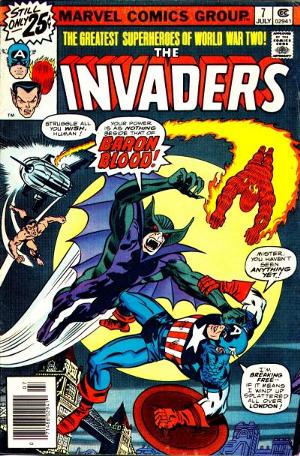
The Invaders #7


Roy Thomas introduces us to the Falsworth’s; an upper-class family that includes World War I hero Union Jack, his daughter Jacqueline (who would later become the plucky heroine Spitfire after a blood transfusion from the android Human Torch) and nephew John, the Nazi vampire Baron Blood.

Obviously team books were what caught my eye during that blazing hot month; more heroes for my pennies, but also some exemplary comics. Steve Englehart’s Avengers (drawn by George Perez) never failed to entertain, and Steve Gerber’s comics left an indelible impact on my early teen self. I personally consider Englehart and Gerber to be the two pillars of Marvel’s Bronze Age, defining the era with their creativity and individual insight.

The Fantastic Four cover had floating heads which was always a must buy, and how could I resist that funky looking vampire on the cover of The Invaders? I don’t recall much of that period of the Fantastic Four - was this when the evil Reed (Brute) Richards from Counter Earth trapped the good one and replaced him on the team? - but I absolutely loved these early issues of The Invaders with art by Frank Robbins.

July ’76 filled my head with alternative Earths, Counter-Earths, giant golden gorillas and dandelion puffs, Bozos and Nazi Vampires, and taught me to stand up for myself for fear of running around at night wearing a night-shirt and cap! It was truly a Bronze Age smorgasbord.


Sunday, 8 July 2012

Giant-Size Avengers #1

In the mid-70s there were some comics I wanted more than all others, and Marvel’s line of Giant-Size comics were undeniably the most coveted. They promised much, yet were denied me because of their non-distribution status in the UK. My hopes were raised by house-ads in the regular comics, and dashed by their lack of availability in the many newsagents I would frequent in my weekly search for new comics.

One in particular fascinated me; the cover of Giant-Size Avengers #1 promised the ‘startling reappearance of the fabled All-Winners Squad’ - a team of Golden Age characters I’d discovered recently in a battered copy of Fantasy Masterpieces #10 - and furthermore, I’d been made aware (most likely by an Editor’s note in a later issue of The Avengers) that it was the comic where it was revealed that The Scarlet Witch and Quicksilver were the children of Bob (The Whizzer) Frank and Madeline (Miss America) Joyce. Being a fledgling continuity obsessive, and fan of stories that filled in the gaps of the rich tapestry the Marvel Universe once was, Giant-Size Avenges #1 made me think this one would live up to Stan Lee’s oft- repeated declaration that ‘This one has it all true-believer’.

I never did get hold of a copy during those formative years, but on eBay all things are available (for a price), and so I now own a copy of this once highly sought after comic.

Was it worth the 38 year wait? It certainly scratched a Bronze Age itch; the story of Nuklo - mutated by the terrible power that had just recently devastated Hiroshima and Nagasaki; a child in possession of uncontrollable force and locked away for 25 years - was a sad acknowledgement of Man’s unknowing use of nuclear energy, written by Roy Thomas and drawn by Rich Buckler (inked by Dan Adkins). However, the reveal of the parentage of the mutant twins was slightly anti-climactic, almost tacked on in Thomas’ quest for a cohesive Marvel Universe. It was likely this lack of a solid underpinning that allowed for the later reveal that the twins were the children of Magneto.

Still, it stands as an interesting artefact of Marvel's Bronze Age. And one can't condemn something for not entirely living up to childhood expectations.

Buy Giant-Size Avengers #1 at My Comic Shop

Saturday, 31 December 2011

The Avengers #98

Cover date: April 1972

Writer: Roy Thomas

Artist: Barry Smith

Inker: Sal Buscema

Following the events of the Kree-Skull War, it’s time for the Avengers to take stock and ask some important questions... like, where is Clint (Goliath) Barton?

Last seen upon an exploding space craft, the gathered heroes are uncertain whether their missing teammate survived; so Thor announces he will return to Asgard (to peer into some mystic mirrors looking for answers), Iron Man reckons Tony Stark (wink wink) has some other resources that’ll help in their search, and Captain America puts on the radio...to discover that a pro-war rally – led by a Mr. Tallon – is taking place in the city.

As acting Chairman, the Vision sends Cap, the Scarlet Witch and Quicksilver (with Rick Jones tagging along) to investigate Mr. Tallon and his Warhawks, but all are soon swayed to the pro-war sentiment by the mysterious music played by Mr. Tallon’s two robed associates.

Meanwhile, Thor has returned to Avengers Mansion, unable to enter Asgard (this tale apparently takes place before, or perhaps after, the ‘legendary’ events of Thor #198). The Vision tries to contact Iron Man, but he too has fallen under the spell of Mr. Tallon; so it is left to the android and the god (both immune to the other-worldly music) to make things right.

The Vision sends Thor to the rally, while he goes to confront Iron Man. After a titanic tussle, Iron Man is freed from the spell when another of the pan pipers is killed in the clash. The two then join Thor, who recognises Mr. Tallon as Ares, the Greek god of war.

As Thor’s mighty hammer is caught in one of the Scarlet Witch’s hex spheres, an explosive arrow flies towards it, disabling the hex and allowing the hammer to return to Thor. The Vision makes quick work of the two remaining pipers, revealing them to be Satyrs, and the crowd (and the other Avengers) are returned to normal. The mysterious archer then makes himself known. It’s Clint Barton, in a hideous new outfit, and again calling himself Hawkeye. Putting off any questions to how he survived being stranded in space, Hawkeye announces he has a companion – an amnesiac Hercules!
This was a strong return to form for Roy Thomas after the mangled climax to the Kree-Skrull War, and he is ably abetted by an ever improving Barry Smith. Smith still has some problems with faces (the eyes are invariably too close together), but his storytelling is effective, clear, and dynamic.

Shame about that new outfit for Hawkeye though; what an eyesore!


Tuesday, 22 June 2010

The Avengers #97

Cover date: March 1972

Writer: Roy Thomas

Artist: John Buscema

Inker: Tom Palmer

I love this cover!

This is the final part of the Kree/Skrull war, and Rick Jones has been hurled into the Negative Zone to be menaced by Annihilus. One quick, unexpected, mind-blast from Rick and Annihilius is beaten, before Rick is transported back to the Supreme Intelligence for an explanation of where the mind-blast came from. It appears Rick is exhibiting the ultimate expression of the evolutionary capacity of the human race – handy that, because he then whips up the Golden Age heroes that appear on the cover, to fight of some Kree soldiers and Ronan the Accuser!

Rick then puts an end to the war by immobilising all the Kree and Skrull troops, before collapsing. Never fear, Captain Mar-Vell is on hand to merge with Rick and restore him to good health.

The Avengers return home, minus one. Clint ‘Goliath’ Barton is missing, presumed dead!

A satisfying conclusion to the first real Marvel epic, spoiled only slightly by some questions regarding just what is going to happen once all those Kree and Skrull come around– the Skrull Armada is still floating around out there in space!

It’s a pity that Neal Adams wasn’t able to complete the story, but Buscema inked by Tom Palmer is more than palatable.

Buy The Avengers #97 at My Comic Shop

Friday, 16 April 2010

The Avengers #96

Cover date: February 1972

Writer: Roy Thomas

Artist: Neal Adams

Inker(s): Palmer, Adams & Weiss

The Avengers - Captain America, Thor, Iron Man, Vision and a powerless Goliath (Clint Barton) - race into deep space on a rescue mission (The Scarlet Witch, Quicksilver and Captain Marvel have been captured by the Skrulls). They encounter a Skrull fleet and much fighting follows. Meanwhile, Rick Jones has been captured by the Kree and comes face to (very large) face with the Supreme Intelligence....

This is a superb example of what makes/made The Avengers so great; Roy Thomas was firing on all cylinders and Neal Adams' art was simply outstanding. A perfect mix of team dynamics, characterisation (early signs of Vision's love for Wanda are on display) and exciting action.

Buy The Avengers #96 at My Comic Shop

Saturday, 13 March 2010

Growing up the Marvel way!

This month marked my last purchase of a new Marvel comic. After the cancellation of Ms Marvel - the last Marvel title I was buying regularly - I no longer have any reason to buy comics from what was once affectionately known as the House of Ideas; the rot set in with Avengers: Disassembled, and I don't feel like continuing anymore.

And yet.....

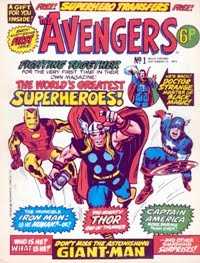
Marvel was my introduction to comics. Growing up in the UK, my voracious appetite for reading was met by the launch of Marvel’s UK line in September 1972. The Mighty World of Marvel, Spider-Man Comics Weekly and, most importantly, The Avengers in September 1973.

The Avengers was my first love super-hero team.

It wasn’t long before I was searching out those mysterious American versions, and my first purchase was The Avengers #114 (cover date August 1973), the introduction of Mantis, Steve Englehart writing, and a cover that has remained a firm favourite.


I was hooked, but with the introduction of Marvel UK The Avengers, the American version soon became non-distributed (to save confusion!), and it wasn’t until I was introduced to the joys of comic shops that I was able to glimpse the covers of my much missed The Avengers (my pocket money at that time didn’t stretch to buying new comics at import prices). This sad state of affairs lasted until early 1976 when The Avengers started appearing in the local newsagents again – I never missed another issue until the mid-Eighties.

With all that in mind, I’ve gradually formulated a plan to revisit what is termed the Marvel Bronze Age.

The first decision to make was where to start, and that led to some serious thought about how I define Marvel’s Bronze Age. The only conclusion I came to was the cover design, and more specifically, the logos.


This logo defines The Avengers for me, and when I did a little research it turned out that The Avengers logo and the definitive 1970’s Fantastic Four logo both appeared in the same month – cover date February 1972.


It all ties back to the year 1972, when I was seven years old.


The second decision was when to end this particular experiment. When did Marvel’s Bronze Age end? I was tempted to go with the appointment of Jim Shooter to editor-in-chief in 1978, but that seemed just a little petty and would have stopped short of one of my favourite The Avengers runs. So I went with the only sensible decision – when The Avengers stopped being fun.


That, ladies and gentlemen, was The Avengers #200, cover date October 1980. The infamous Rape of Ms Marvel. I was fifteen by then, and I knew that was a bad thing.


I have no doubts this will be a huge undertaking, and there is no guarantee I will ever finish it; but it will be fun trying, and revisiting those eight formative years.


I will, of course, have to purchase a lot of these comics for the first time, so the reading experience will be like new. I realise I could just go and buy all the various Essentials that are now available, but I want the reading experience to be as authentic as possible – letter pages, house ads, and editorial pages included. It will also include a lot of drudgery – I never particularly warmed to certain characters (Spider-Man, Thor, Dr Strange to name a few), but I may also learn to, if not love them, at least appreciate them.


First up – Fantastic Four #119
Related Posts Plugin for WordPress, Blogger...